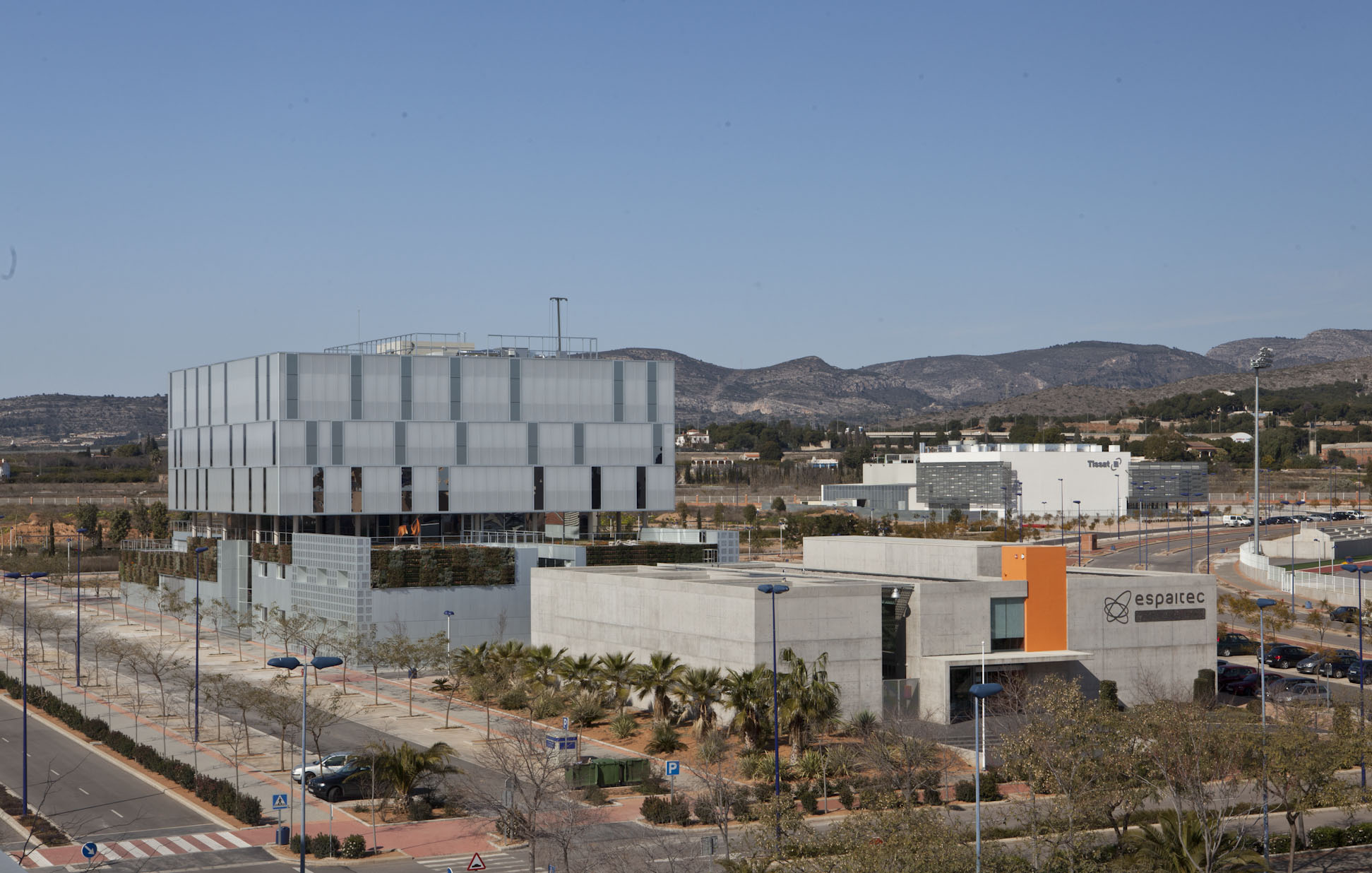


Espaitec has hosted the Innotransfer event "Connect to Take Off: Aerospace Technology", an initiative promoted by the Valencian Network of Science Parks (rePCV), with the support of the Ministry of Industry, Tourism, Innovation and Trade
podcast This Thursday, May 28, 2026, the conference was held Innotransfer «Connect to Take Off: Aerospace TechnologyThe event analyzed the challenges and opportunities of a rapidly expanding sector, showcased the innovative technologies being implemented, and highlighted how cooperation between universities and companies in the region enables aerospace development. The Director of Innovation and Entrepreneurship at Universitat Jaume I, Marisa Flor; the Deputy Director General for the Advancement of Digital Society and Digital Enabling Technologies, Francis Xavier Sogorb; and the director of Espaitec, Juan Antonio BertolinThey have inaugurated the event.
Flower has highlighted "The diversity of areas that can provide solutions to the sector, as well as the potential of these conferences to promote new alliances and collaborations". For its part, Sogorb has indicated that "For the General Directorate of Innovation of the Valencian Government, it is a pleasure to collaborate with the Valencian Science Parks Network, given that they are fundamental actors for innovation that drive the research ecosystem of universities, promoting the transfer of knowledge to companies in our territory, and providing them with competitiveness.".
Bertolin has added that “Castellón has decades of accumulated knowledge working with materials at extreme temperatures, sintering processes, and quality control. And it has an airport that houses the European Space Agency's incubator. The gap between these two worlds is a huge opportunity. Going from manufacturing the best flooring in the world to manufacturing the materials that protect rockets isn't a leap into the void. It's connecting two existing points, and events like this Innotransfer Aerospace are precisely the mechanism to make it possible.”.
The session has begun with the presentation "New Lunar Communication and Navigation Infrastructures: Towards a New Paradigm in Lunar Exploration" de Javier Ventura-Traveset, responsible for Navigation and Lunar Science at the European Space Agency (ESA), who has detailed the mission Artemis 2The exhibition highlighted the important role of the European aerospace contribution, the current state of lunar exploration, and the growing collaboration between space agencies and private industry. It focused particularly on the development of new lunar communication and navigation infrastructures and services driven by the European Space Agency through its programs. Lunar Pathfinder, Moonlight y NovaMoonThese initiatives will provide critical capabilities for future scientific, robotic, and crewed missions, enabling a new operating model for the Moon, and, in parallel, the first private missions to the lunar surface have begun, opening a new stage in the commercialization of space exploration.
The day continued with the round table "Connecting the Ecosystem: New Space Initiatives and Agents", Involving David Argilés, managing director of Val Space Valencian Space Consortium; Ivana Guinot, director of Castellón Airport; and Pepe NietoPresident of Espai Aero Comunitat Valenciana. In this regard, they all shared the important role played by these entities, along with the initiatives being developed to promote the aerospace ecosystem in the Valencian Community.
Next, the round table discussion began. "Technological Institutes: Engine of Innovation" where they have intervened Yolanda Reig, general director at the Institute of Ceramic Technology (ITC-AICE); and Guillermo Ulldemolins, leader of the Sustainable Mobility and Future Cell at AIMPLAS. Both speakers presented the technologies being implemented in the field of materials, focusing on the fact that the aerospace sector needs to reduce weight and emissions, but also increase production rate, repeatability and industrial capacity without always depending on the autoclave, the combination of material, process, design and validation being an indispensable element, and above all, that the challenge is not only to develop the material, but to make it industrializable, controlling the microstructure, reproducibility, processing temperature and scale-up.
The session has progressed with the round table "Success Stories: Technology and Transfer in Action", with the interventions of Sergio Soler, CFO and co-founder of Arkadia Space; Guillermo JenaroCEO and co-founder of Collimate Space; and Jorge Simancas, a researcher from the Advanced Semiconductors Group at INAM-UJI. All of them have presented various innovative technologies that they have developed and applied in the aerospace sector. In this regard, it is worth highlighting, in the case of INAM-UJI, the advances achieved with perovskite, a mineral composed mainly of calcium oxide and titanium.
Once the round tables are over, Sara Escrig, Innotransfer manager at Espaitec, has given a practical presentation about the "Innotransfer Challenges Platform: Collaboration Opportunities", in which any company or entity with a presence in the Valencian Community can propose a technological and innovative challenge to be solved by the research staff of the Valencian public universities and the network of REDIT Technological Institutes.
To close the day, he intervened Juan Antonio Bertolin, director of Espaitec, who has highlighted that “In 2013, Espaitec was only six years old. That year, we met Bruno Naulais, ESA BIC Network Manager, and expressed our interest in joining the initiative that was taking shape. Perhaps we were a bit bold given our size, but we were very eager to be part of the change brewing in Europe—the first ESA BIC in Madrid, the second in Barcelona. Naulais recommended we contact Javier Ventura-Traveset, then Head of Communication at ESAC, to share our interest. Being so small, our desire to enter the aerospace world wasn't easy.” But thanks to that first step, together with ValSpace, David Argiles, and the Valencian Science Parks Network, the same promoters of Innotransfer who bring us together today at Espaitec, we were able to form a team to lead the European Satellite Navigation Competitions in the Valencian Region between 2014 and 2018. An enormously enriching period, which has reconnected Espaitec with the aerospace sector 13 years later.”Finally, he thanked the speakers and attendees for their participation in the event.
Innotransfer
Innotransfer It is a multi-sectoral initiative of open innovation and collective management that aims to promote the transfer of knowledge and technology, developed by the science and technology parks of the Valencian Community, to the business ecosystem of our territory in key economic sectors such as water; Artificial Intelligence; sustainable habitat; agri-food; sustainable mobility and automotive; enabling technologies; health; infrastructure; smart tourism; and aerospace.
The main business associations, the Valencian public universities and the REDIT Network of Technological Institutes They participate in the Innotransfer program, coordinated by the Valencian Science Parks Network (rePCV) and funded by the Valencian Regional Government's Ministry of Industry, Tourism, Innovation and Trade. This initiative aims to foster dialogue between researchers and companies in the Valencian Community through the catalytic action of the intermediary structures of the public-private research ecosystem and the Valencian business ecosystem.